Physical Address
304 North Cardinal St.
Dorchester Center, MA 02124
Physical Address
304 North Cardinal St.
Dorchester Center, MA 02124

Bạn có bao giờ ngẩng đầu nhìn trời đêm rồi tự hỏi cách gọi những hành tinh kia bằng tiếng Anh như thế nào không? Bài viết này sẽ dẫn dắt bạn qua toàn bộ “Hệ Mặt Trời tiếng Anh” — từ giới thiệu ngắn gọn, cách viết và phát âm tên các hành tinh, tới thứ tự của chúng. Chúng ta sẽ so sánh danh sách 8 hành tinh hiện tại với quan điểm từng có 9 hành tinh (Pluto), chuyển ngữ sang tiếng Việt, và cả việc ai là “hành tinh nóng nhất” trong Hệ Mặt Trời. Nếu bạn muốn vừa học tiếng Anh vừa hiểu thêm về vũ trụ quanh ta, hãy cùng khám phá nhé.
About 4.6 billion years ago a region of a giant cloud of gas and dust began to collapse under gravity. As the material fell inward the center became hot and dense and formed the Sun, while the remaining dust and gas flattened into a disk and gradually clumped together to make planets, moons and smaller bodies.
In English we call this system the Solar System. It contains eight planets — Mercury, Venus, Earth, Mars, Jupiter, Saturn, Uranus and Neptune — plus many moons, asteroids, comets and dwarf planets like Pluto. Each planet has its own features: gas giants, rocky worlds, rings and different atmospheres that make them fascinating to study.
Learning the English names and pronunciation of these objects is useful for travel, school and tests like IELTS. Simple words such as Earth, Mars or Jupiter often appear in vocabulary lists and illustrations for children and learners. Take time to picture each planet, and you’ll find the Solar System becomes easier and more fun to remember.

Let me introduce the Solar System in a simple, friendly way. Our Solar System has the Sun at its center and eight planets that travel around it in regular orbits. It lives inside a huge galaxy full of stars. Each planet is different—some have thick atmospheres, some are rocky, and some are giant balls of gas—so every world tells its own story.
Earth, also called the Green Planet, is our shared home for nearly eight billion people. It has a protective atmosphere that keeps us warm and safe, lots of water, and diverse life from deep oceans to tall forests. Earth’s orbit keeps it at the right distance from the Sun, allowing plants and animals to grow and seasons to change.
People send rockets and astronauts into space to learn more about planets and moons. Looking at colorful images, listening to fun explanations, and learning words like orbit, atmosphere, astronaut, and galaxy makes exploring space exciting and easy to remember. Space is full of wonders waiting for curious minds.
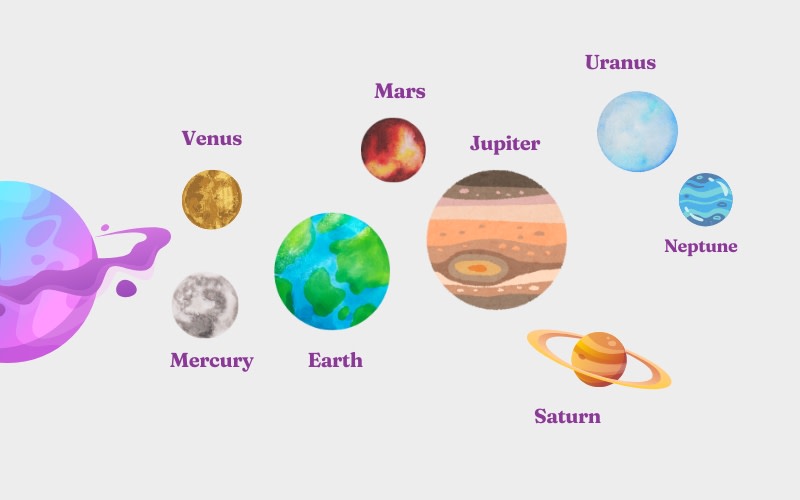
Hệ Mặt Trời trong tiếng Anh gọi là Solar System, là hệ hành tinh mà Mặt Trời là ngôi sao trung tâm; quanh đó còn có tiểu hành tinh, sao chổi và bụi vũ trụ. The Solar System is the Sun-centered family of planets, asteroids, comets and dust that orbit our star, forming the cosmic neighborhood we live in.
Các hành tinh lần lượt là: Sao Thủy (Mercury), Sao Kim (Venus), Trái Đất (Earth), Sao Hỏa (Mars), Sao Mộc (Jupiter), Sao Thổ (Saturn), Sao Thiên Vương (Uranus) và Sao Hải Vương (Neptune). Learning the planet names in both languages makes it easier to talk about space and remember words like Sun, Planet, Star or Solar eclipse.
Bạn có thể học qua video song ngữ bằng tiếng Việt và tiếng Anh với hình ảnh minh họa sinh động, giọng đọc dễ thương và nhạc nền vui nhộn — phù hợp cho bé từ 3 tuổi và cả người lớn mới bắt đầu. Watch, repeat and have fun; combining visuals, sound and simple vocabulary is a great way to learn.
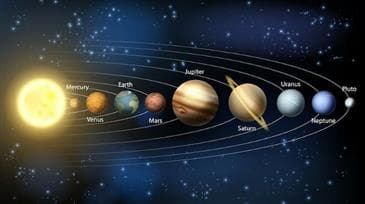
The Solar System has eight planets that orbit the Sun, and we usually divide them into two groups: the inner planets and the outer planets. The inner ones are smaller and rocky, while the outer ones are much larger and made mostly of gas or ice. Learning their English names is simple and fun.
The inner planets are Mercury (Sao Thủy), Venus (Sao Kim), Earth (Trái Đất) and Mars (Sao Hỏa). Mercury is closest to the Sun, Venus shines brightly, Earth is our home, and Mars looks red. These four are compact with solid surfaces, so they’re often called the terrestrial planets.
The outer planets are Jupiter (Sao Mộc), Saturn (Sao Thổ), Uranus (Sao Thiên Vương) and Neptune (Sao Hải Vương). Jupiter and Saturn are giant gas planets with many moons and Saturn’s famous rings; Uranus and Neptune are colder ice giants farther out. Try saying the English names aloud with your child and add words like “meteorite,” “atmosphere,” and “astronaut” for more space fun.
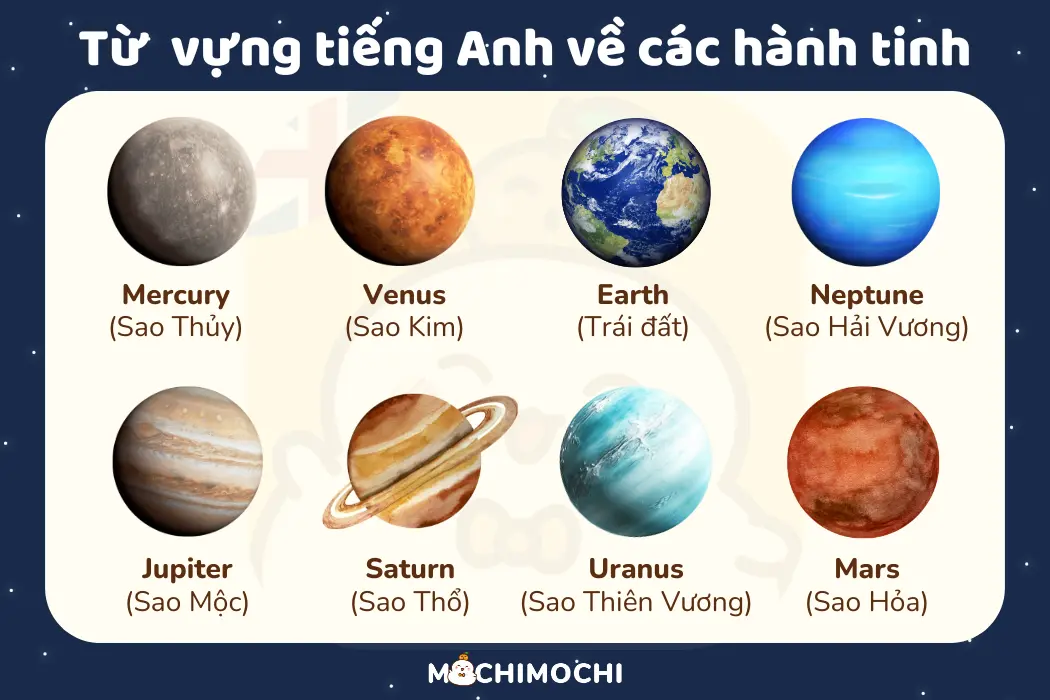
Starting from the Sun, the eight planets are Mercury, Venus, Earth, Mars, Jupiter, Saturn, Uranus, and Neptune. Saying them in English makes it easy to remember their order: small rocky worlds like Mercury and Mars are close to the Sun, while giant gas planets like Jupiter and Saturn sit farther out.
Earth has a protective atmosphere that supports life, and its orbit keeps seasons changing. Mars, with dusty skies and cold deserts, has fascinated scientists and astronauts alike. Beyond Mars, Jupiter’s massive gravity shapes the system, and Saturn’s stunning rings are visible even with small telescopes from Earth.
Learning planet names also introduces useful vocabulary: orbit (the path a body follows), atmosphere (the layer of gases around a planet), astronaut (a person who travels in space), and galaxy (a huge collection of stars). Saying these words aloud helps children and learners remember not only names but also basic space ideas.
.jpg)
Trong Hệ Mặt Trời có 8 hành tinh mà chúng ta thường học bằng tiếng Anh và tiếng Việt: Mercury (Sao Thủy), Venus (Sao Kim), Earth /ɜːθ/ (Trái Đất), Mars /mɑːz/ (Sao Hỏa), Jupiter /ˈdʒuːpɪtə(r)/ (Sao Mộc), Saturn (Sao Thổ), Uranus (Sao Thiên Vương) và Neptune (Sao Hải Vương).
Người ta chia hành tinh thành hai nhóm: nội (Mercury, Venus, Earth, Mars) — là hành tinh đá — và ngoại (Jupiter, Saturn, Uranus, Neptune) — phần lớn là khổng lồ khí hoặc băng khí, có kích thước lớn hơn.
Một vài điều thú vị: Earth là hành tinh duy nhất biết có sự sống; Mars nổi tiếng vì bề mặt đỏ; Jupiter là lớn nhất; Saturn có vành đai nổi bật; Uranus quay nghiêng đáng chú ý và Neptune nằm rất xa, rất lạnh. Nhớ tên tiếng Anh kèm tên Việt sẽ giúp bạn dễ hình dung hơn khi xem hình ảnh hoặc video.
Bạn có thể vừa xem ảnh minh họa, vừa nghe phát âm (ví dụ Mercury /ˈmɜː.kjʊ.ri/) để luyện. Những từ này rất hữu ích khi tìm hiểu vũ trụ — chúc bạn học vui và khám phá thêm!
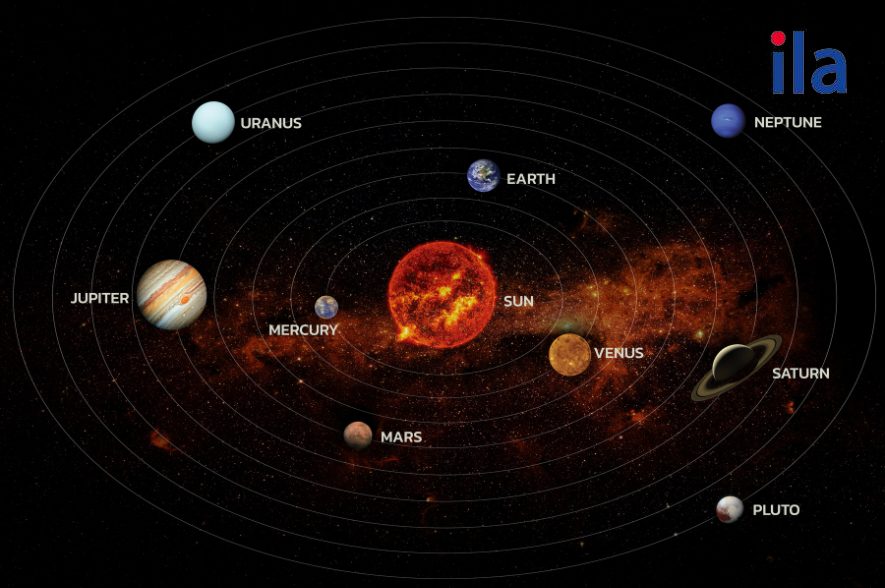
Let’s take a friendly tour of the nine planets in our Solar System: Mercury, Venus, Earth, Mars, Jupiter, Saturn, Uranus, Neptune, and Pluto. Each world has its own orbit and atmosphere, and people study them with telescopes and spacecraft. Knowing the names in English is a fun first step.
Near the Sun are the rocky inner planets. Mercury is tiny and very hot, while Venus is covered by thick clouds and a super‑hot atmosphere. Earth is our home with liquid water and life, and Mars is the red planet, colder and dusty but interesting because of signs of past water.
Beyond Mars come the giant planets. Jupiter is a massive gas giant with a famous storm, and Saturn has beautiful rings. Uranus tilts on its side and is icy, Neptune is deep blue and very windy, and Pluto is a small, icy world that reminds us how our ideas about planets can change.

Kết lại, bài viết đã giúp bạn nắm vững từ vựng về Hệ Mặt Trời bằng tiếng Anh, cách viết, tên các hành tinh cùng thứ tự của chúng, và cả câu chuyện 8 hay 9 hành tinh cũng như hành tinh nóng nhất. Hy vọng những kiến thức vừa ngắn gọn vừa thực tế này sẽ giúp bạn tự tin hơn khi đọc, viết và nói về vũ trụ bằng tiếng Anh. Hãy ghi nhớ tên từng hành tinh, luyện tập qua câu chuyện hoặc bài hát, và giữ ngọn lửa tò mò về không gian luôn cháy. Chỉ cần một chút kiên nhẫn, bạn sẽ tiến bộ rất nhanh — chúc bạn học tốt và tiếp tục khám phá!